
Iris for Remembrance
Basking in recalled Joy

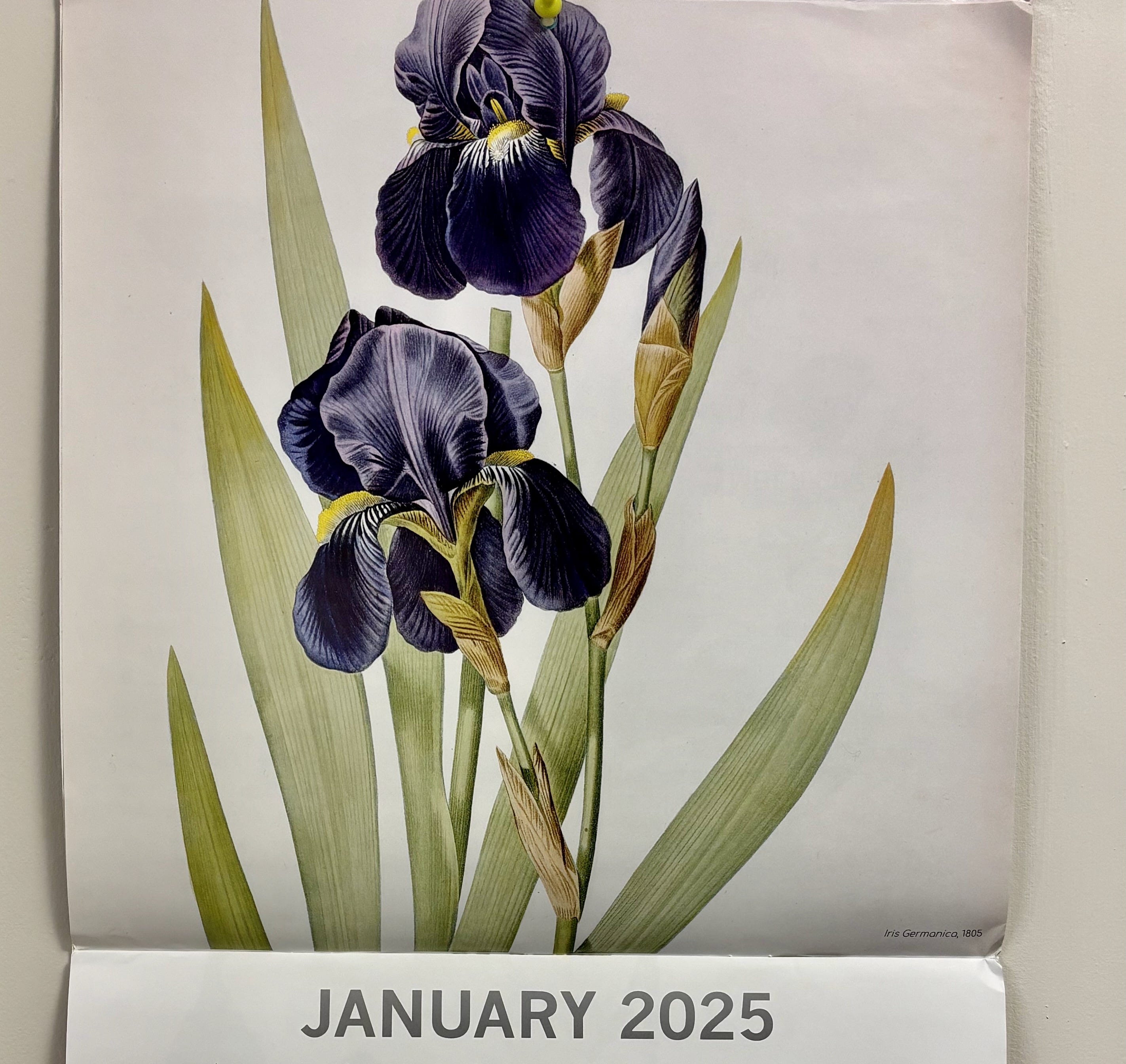
As we turn the calendar to a new year, it is natural to look both back and forward. January is, after all, named after Janus, the Roman animistic spirit of doorways and entrances, depicted with two faces and able to look both ways. In my home, every year for at least the last decade, we would put up a “Redouté” calendar. My late wife Patti was a keen and knowledgeable gardener, and she loved flowers. In particular, she was always delighted by the botanical illustrations of the 18th-century French artist Pierre-Joseph Redouté. After our first Redouté calendar, we just had to have another every year.
These were getting harder and harder to find as wall calendars have fallen out of fashion. Apparently, floral illustrations are not as reliable sellers as kittens, puppies, and Purple Mountain Majesties. In 2024, thankfully, I started my Redouté calendar hunt right after Labor Day. I had no luck on Amazon or Calendar.com, but happily, an online search turned up a hit on eBay in Australia; I quickly bought a copy and it duly arrived in late September.
I eagerly took it to the hospital to show it to Patti, and her face lit up like a child’s on Christmas morning; reflecting unbridled joy, even though she knew then, as I didn’t yet, that she would never use it. She saw it for exactly what it was, a little token of love.
I have never had an Australian calendar before. In addition to Christian, Muslim, and Jewish holidays, this one marks out such unfamiliar celebrations as Eight Hour Day Day (March 10, Tasmania) and Melbourne Cup Day (November 4, Victoria). The King’s Birthday is also a day of note, although it seems to be a moveable feast, celebrated on June 2 in New Zealand, June 9 in New South Wales and Victoria, September 29 in Western Australia, and October 6 in Queensland. Are we dealing with four different kings or just one who liked parties?
All of these commemorative occasions, religious and secular, are there to connect us to a “shared” past. Even if that past is only one we learned in school, Church, Masjid, or Shul, signifying no more than a day of rest to us, special days are useful as a little bit of glue to help communities stick together through the years.
Antipodean holidays in this sense mean nothing to me, but the Iris in the illustration does have meaning on a couple of levels, First, it has a family significance evoking my childhood and my maternal grandmother. That’s a story for another day, but cultures more broadly often attach meanings to flowers.
In the “language of flowers,” Iris symbolizes remembrance. In Greek mythology, Iris was the goddess of the rainbow and the messenger of the gods. The iris flower is said to have been created by her to act as a bridge between heaven and earth. As such, it seems a suitable illustration for January, the bridge between the old and the new.
And so, the last Redouté calendar I will ever own is up on my kitchen wall, a rectangle of recalled joy and remembered love. Like Janus, it guards the door beside it, protecting my modest home and promising to watch over it when I leave, and welcoming me back to the sweet sorrow of past joy and future peace when I return.