
Better Boycotts
Be sure of your Goals

As I write this, the new US Administration has been in place for nine days, and it is already creating quite a stir worldwide. By threatening to impose punitive tariffs on its trading partners, it is seeking to force concessions in non-trade areas as well as getting better trade deals.
For example, last Sunday Columbia tried a little bit of defiance, at first refusing to accept a planeload of Colombian nationals who had entered the US illegally and then committed crimes, whom the US was returning to Columbia. The president of Columbia possibly forgot for a moment that he was dealing with a batshit-crazy narcissist who cannot be seen to lose face. Four hours later the little rebellion was over, and Columbia acceded to all US demands
Bullying and theater aside, there is a real US policy objective at play; To reduce China's hold over the US - acquired over the years due to persistent trade deficits. Mexico and Canada are also coming in for threats of 25% tariffs on everything, for analogous reasons. Moreover, the implementation plan seems to change daily, likely because they are making it up as they go along.
This is a big deal in Canada, as the US is our largest trading partner by far. If these tariffs are implemented, plenty of jobs (and votes) will be threatened. The crisis comes at an unfortunate time, too: We have effectively no Prime Minister, as the current one has announced his resignation and a new one can’t be appointed until after March 9.
The outgoing PM has commented on the situation, though, and his solution is ketchup. Recently, he was quoted reflecting on a 2018 dispute with the US during President Trump’s first term. “The example from last time was Heinz’s ketchup being replaced by French ketchup because French ketchup was still using Canadian tomatoes in its ketchup,” Trudeau reportedly said. He was referring to the Great Ketchup Boycott of 2016, about which more later.
First, let us acknowledge that there actually is a problem to be dealt with here; Canada’s trade surplus with the US has been running at 5 to 10 Billion (with a “B” ) Canadian dollars per month ( month with an “M”). After several years, even counting in Loonies, $10 billion per month can add up to some serious change.
Faced with the vacuum at the top, Canadians have begun to discuss how they can personally deal with the threats emanating from the new US administration. Unsurprisingly, boycotting American goods and services or refusing to travel to the US are popular choices. Our National Newspaper of Record (English language version) sent an intrepid reporter this week to ask “the man in the street” what he is doing about the Trump threats. My favorite response was from the fellow who said, apparently unironically, “With my weekly shop at Costco, I am looking carefully at the labels, and choosing “made in Canada” whenever I can”.
Boycotts have a spotty track record at the best of times (Russian oil, anyone?)., and based on the foregoing, we in Canada are clearly hopeless at them. Someone has to step in with a simple, actionable, effective plan, so here it is. You’re welcome.
Maybe Start with China
Unlike the US, Canada has a huge and persistent trade deficit with China; we buy all kinds of stuff with a tiny “Made in China” label. - they buy virtually nothing but raw materials from us. Plus China’s government is a brutal dictatorship that has an appalling human rights record, dissidents disappear never to be seen again, the Uighur minority in the West is systematically being ethnically cleansed - I could go on. If Climate change is your bag, China is the world’s largest emitter of greenhouse gases, the largest producer and consumer of coal, and the largest importer of oil and gas. Its banks are among the largest financiers of fossil-fuel operations in the world. Want to make the world better with your boycott? Choose China, you are spoiled for choice.
Hit High Profits First
China was just a warm-up, of course, to get your boycotting muscles in shape before directly addressing Orange Man. The first principle is to hit profits, not revenues - boycotting low-margin, easily replaced goods is a mug’s game - nobody cares - aim for things that are almost pure profit first, so…
Cancel Your Netflix Subscription - think Trump was the first to call us the 51st state? Nah - in its reporting, Netflix lumps us together with the US, there is no special Canadian content - your subscription is pure profit flowing south. Cancel it
Ditto Disney+ etc. The whole entertainment complex is very high margin - so you can jack in Hollywood movies, Taylor Swift concerts, and NFL Football. the lot - don’t watch any of it - they all get paid by the eyeball. The good news? CRTC rules force Canadian Broadcasters to show a certain quota of Canadian Content -watch it, some of it might be good - nobody knows.
Stay away from social media. Do I even have to mention Musk, Zuckerberg, and the rest? Those apps are pure gold for the US. Delete, and while you are at it, best to use your phone to make calls only. All the rest of the apps in the app stores pay fat fees to Apple or Google.
After you’ve done all the above, and you’ve got more appetite for boycotting, move on to
Dining out and Hospitality
In the middle-profit margins category are the Hospitality industries, like hotels and restaurants. Your boycott of US travel fits in this group, but start at home with Coffee shops - the highest margin sub-group
No Starbucks (of course) but also be wary of Tim Hortons (owned by Restaurant Brands International) US shareholders own the majority - Find a local independent coffee shop to be safe.
Be careful with fast food - Avoid McDonalds, Burger King, Wendy’s, KFC, Taco Bell, Domino’s, etc.
Hotels - 10 of the top 12 hotel chains in the world are US-owned, so even if you never travel to the US, travel is problematic. FYI, the two exceptions are Accor (France; Novotel) and IHG (UK; Holiday Inn). Airbnb has local hosts, but a fat fee goes you-know-where.
Cruises - Don’t cruise — all of the brands, even ones with foreign-sounding names like Norwegian and Holland America are US-owned, Registered in tax havens like the Bahamas, with US administrative headquarters and employees recruited from low-wage countries like the Philippines. If you really must cruise, there are a couple of exceptions you could Google. (oops, sorry)
Retail
Our last Category Is retail, and here we are much better off. There are plenty of Canadian-owned retailers in every town and city, and country-of-origin labels are required on packaged goods, so you can spend as much time as you like peering at the small print at the back before making a choice. Let’s start first with large ticket items.
Vehicles. -Chevrolet Silverado, Chrysler Pacifica, Chrysler Grand Caravan, Dodge Charger, Honda Civic, Honda CR-V, Lexus RX, Toyota RAV4, Lexus NX. This is the complete list of vehicles currently being built in Canada. Frankly, though, the whole Automotive sector is a boycotter’s nightmare - parts built here, engineering done there, corporate ownership somewhere else- let’s just forget about vehicles and move on to
General Merchants- The largest retail conglomerate in Canada is the George Weston group (Loblaws, Shoppers Drug Mart, many, many more) It is very much Canadian-owned. The next three are
Costco
Wal-Mart
Amazon
All problematic. It goes without saying, I hope, that rather than looking at labels at Costco, It is much more effective not to go there in the first place. Don’t go to Walmart or buy from Amazon either. In addition to these 3, maybe stay away from Home Depot, Rona, Winners, Home Sense, Marshalls, and Best Buy, and you’ve got retail more or less covered.
That’s it, your complete guide to fighting the Trump tariffs. Participate as little or as much as you like, just be sure to do things in the correct order, for maximum effect.
Oh, and I promised that I would tell you
The Ketchup Story
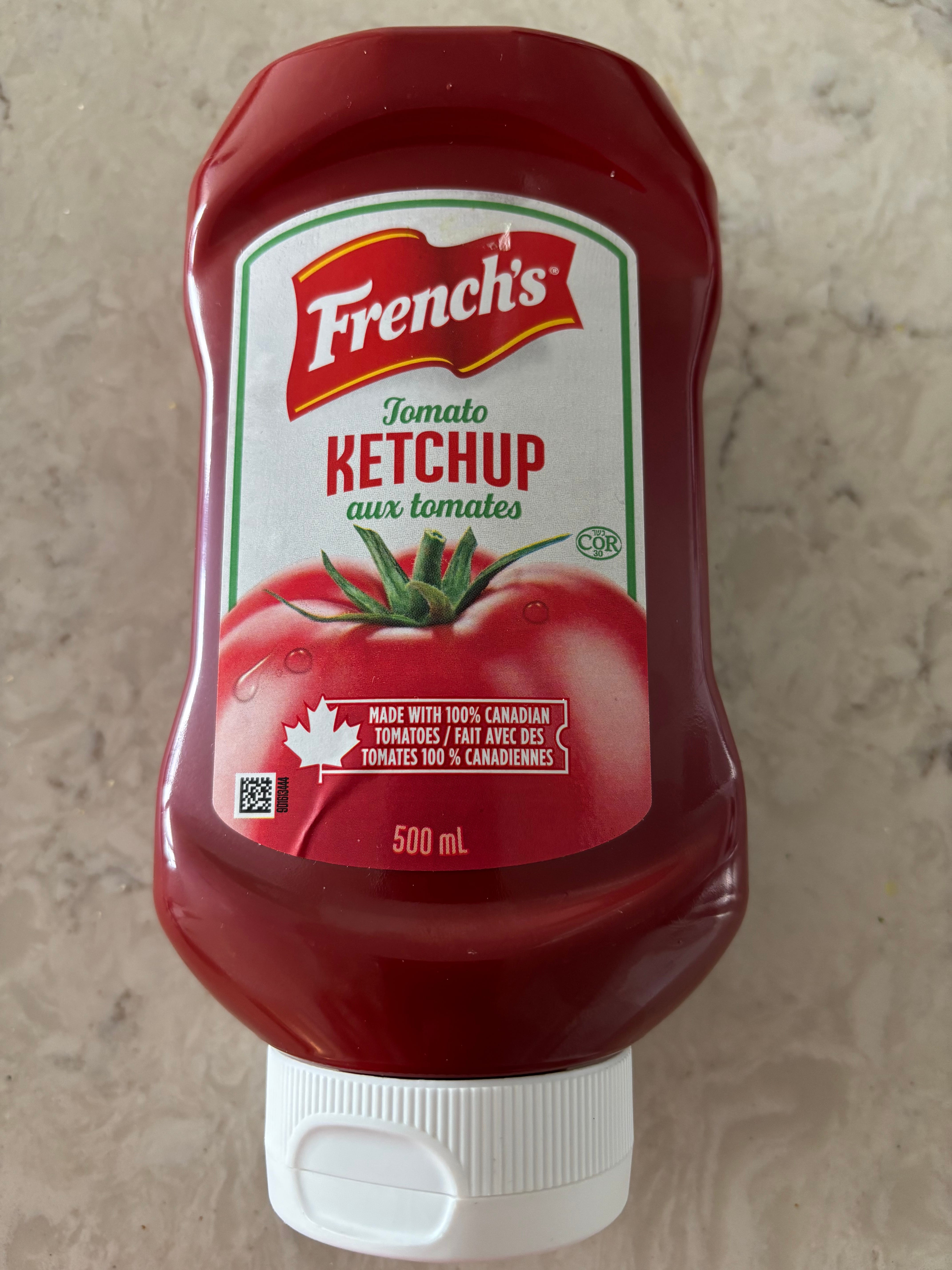
In 2015 the American Food Conglomerate KraftHeinz announced that it was closing its Ketchup bottling plant in Leamington, Ontario, and moving production to the US. Tomatoes were and are a major crop in the area and they are processed into peeled, diced, and various sauces for other labels, plus ketchup for Heinz. The plant was duly shut, but another American Food Congromate, McCormick, owner of French’s Mustard, among many other brands, saw an opportunity. They added a Ketchup line to their nearby processing plant and, slapping a maple leaf on the label, began grabbing shelf space in Canadian supermarkets. (See photo above) Soon patriotic Canadians were merrily posting their boycott of Heinz and their French’s purchases on Instagram and Facebook (I know, right). Heinz found itself losing much more share than they had anticipated.
In 2018, Canada the US, and Mexico renegotiated their free trade agreement, and Trudeau was no doubt briefed about Made-in-Canada ketchup at the time, although the implication he left that it had anything to do with the Government is false. What Trudeau didn’t say, or maybe doesn’t know, is that Heinz is making ketchup in Canada again, After receiving a $2.3 million incentive from the Quebec government, Heinz added a ketchup line to a processing plant near Montreal in 2020. To recapture market share, they slapped an even bigger white maple leaf on their labels.
Since these two brands dominate the market, the ketchup shelves in our supermarkets are a riot of patriotism. Inverse Canadian flags everywhere - white maple leaves on a red ketchup background - two US multinationals proudly displaying how Canadian their ketchup is.
It's pretty hard to reduce the US influence on your life
I will try to stay away from the American Companies..Amazon would be a hard one though as they are very convenient!